I am an artist working in the field of ceramics creating fragile porcelain pieces which are inspired by the environment or by peoples relationships with the environment and with each other and which often incorporate finds to support their narrative.
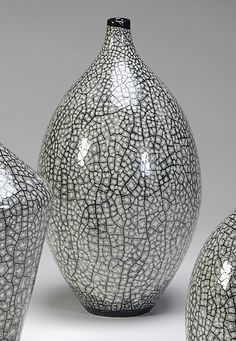
This week I visited a gallery, Spindrift, in Portscatho, which is local to me in Cornwall. They have a good selection of ceramics, much of it quite functional and very lovely. Most of it by local artists. So I reached up to a high shelf and pointed to a pair of lovely green bottles. They had a generous, welcoming shape but what intrigued me was the surface finish. At first sight I thought that a crackle glaze might have been used, but that didn’t look quite right. Were they raku fired? No, the mottled effect was the colour IN the lines, which was a really lovely green. What secrets were hidden here?
I commented on the vessels and asked if I might lift one down. ” Those?” uttered the owner of the gallery with a slight twinkle in his eye, “By all means, but they are not for sale. I bought them in a well known DIY shop a few years ago. They cost £8:00 and I wanted them to hide my wifi.” Oh how embarrassing! I am supposed to know about ceramics now. I have a diploma so I must do, right? Wrong! I know nothing except how much I don’t know!
In fact I was reassured later in my conversation with the gallery owner, Fred, who told me that I was by no means the first person to be taken in by the vases. He told me about the people who ‘knew it all’ and who would come in and tell their companions all about the techniques used and be completely incorrect about their theories. In fact, I discovered, egg shell had played a crucial role in the creation of the surface. I rushed home to look it up.
I can feel an idea hatching . . . .It transpired that this is done by a type of inlaying by the Chinese. I found a U-tube video showing me how to do it and all sorts of images and instructions. It got me wondering though. How else might egg shell have been used in ceramics? It is a great source of calcium which I know to be a secondary flux. Fluxes are used to lower the melting point of the glass formers in a glaze. Secondary fluxes only become active at higher temperatures and within that higher range calcium is a fairly useful addition to many a glaze recipe so . . . . what would happen? I wonder . . . . . I feel some trials coming on as soon as I get back from my self imposed holiday from the studio. Watch this space . . . .
Barbara Hepworth, Two forms. 1937Three Forms 1935 Dame Barbara Hepworth 1903-1975 Presented by Mr and Mrs J.R. Marcus Brumwell 1964 http://www.tate.org.uk/art/work/T00696, aching to be gently stroked!
I have wanted to renew my acquaintance with Barbara Hepworth for some time and what better opportunity than the exhibition Sculpture for a Modern World in London this summer.
Hepworth always used to make it into my list of strong influences but over the past two years, during the diploma she has been superseded by a number of ceramic artists and it is not done to list too many influences on ones profile etc and so poor old Barbara became relegated to the back pages for a bit. However, having been to the Tate Britain the other day and met a number of old friends and a few new and fabulous pieces, she is going back where she belongs, along side Richard Long and Adam Buick. The exhibition follows Barbara Hepworth’s rise to fame and included a number of pieces by other artists who were an influence on her work, including sculptures by Gill and paintings by Ben Nicholson. So maybe, if I make a clear note here that she is one of my major influences, then when Tate Britain does a retrospective on the Life and Works of Bridget Macklin they will remember to include a couple of her pieces alongside mine!
So why do I love her work so much? Because she was right – about so much, but importantly about relationships between making and the ideas. Actually, I think I should let her speak for herself on this because she put it so much better than I can.
‘There must be a perfect unity between the idea, the substance and the dimension: this unity gives scale. The idea – the imaginative concept – actually is the giving of life and vitality to material; but when we come to define these qualities we find that they have very little to do with the physical aspect of the sculpture. When we say that a great sculpture has vision, power, vitality, scale, poise, form or beauty, we are not speaking of physical attributes. Vitality is not a physical, organic attribute of sculpture – it is a spiritual inner life. Power is not man power or physical capacity – it is an inner force and energy. Form realisation is not just any three-dimensional mass – it is the chosen, perfect form, of perfect size and shape, for the sculptural embodiment of the idea. Vision is not sight – it is the perception of the mind. It is the discernment of the reality of life, a piecing of the superficial surfaces of material existence, that gives a work of art its own life and purpose and significant power.’ (Barbara Hepworth in Sculpture, Circle: International Survey of Constructive Art 1937. Taken from the Tate Britain hand out for the exhibition Sculpture of a Modern World).
I believe that, as makers, we would all do well to have these words tattooed on our arms so that as we are working we can refer to them constantly and never lose sight of what we are doing. As I explored the exhibition I experienced a wonderful inner tranquillity which stemmed from being in the presence of so many beautiful and balanced forms. Just one little thing though, these sculptures ache to be felt. When you visit the Barbara Hepworth Museum and Garden in St Ives, Cornwall, you can walk amongst the sculptures and get up close and personal. Here, in the rarefied atmosphere of London it would give the curators an apoplectic fit if you went within a mile of the pieces. I would like the Tate to take note that, when the time comes for my retrospective, there are to be no glass cases and the pieces are to be available for all the senses, touch included.
![1231190.large[1]](https://bridgetmacklin.com/wp-content/uploads/2015/08/1231190-large1.jpg)
![barbara-hepworth-two-forms-1937-copy[1]](https://bridgetmacklin.com/wp-content/uploads/2015/08/barbara-hepworth-two-forms-1937-copy1.jpg)

 Bridget Macklin