Does Skill Matter?

My instant response to the above question is yes, of course it does!  But hang on a second, if that is the case how do we explain the success of Du Champ’s Read Mades, or Andy Warhol’s Brillo Boxes.  Surely there is not a lot of skill there – anyone can plonk a box of cleaning materials on a plinth or screw a urinal to the wall.  And yet these pieces are universally recognised as great, much talked about and very well known pieces of art.  So maybe skill does not matter at all.  If that is the case then, why does going to art college seem so important?  Why am I spending every free moment working on technique and glaze chemistry?

Marcel Duchamp, Fountain.
Andy Warhol, Brillo Soap Pads
Anish Kapoor Marsyas 2002 07
Anish Kapoor, Marsyas. 2002

Artists like Damien Hurst and Anish Kapoor employ a workshop full of artists to make for them.  I remember having a fierce argument with a fellow student when studying at Bath Spa where I maintained that it was cheating if, as an artist, you did not actually make the work.  Several years on I have changed my point of view.  I find myself appreciating that there is skill in the idea and that it might be better if someone with more technical acumen actually executed that idea according to your instructions.  If, as an artist, your piece requires a considerable degree of careful mould making or engineering then perhaps there is justification in getting a skilled technician to follow your design brief.  Does this mean that the work is yours or theirs?  If the work of art is about the idea and the semiotics within that idea are yours, then isn’t that a high level artistic skill?

Damien Hurst, For The Love of God

I suppose that as a ceramic artist, much of the “art” is in the tactile nature of the material and in the making.  In which case, surely ceramics requires the artist to be the maker.  yet, on reflection, maybe that also rather depends.  An artist who relies on their skill on the wheel to throw vessels must surely get their hands dirty and ‘feel the clay’.  But even here, they might only be the ideas person who, having given shape to the idea , would chose to pass it on to others to follow instructions. Who, then, is the artist?

As I get drawn further into my course I become more and more aware of what I can’t do!  What of the skills which I lack – do they matter?  Or am I going to reach a point when I decide that I know what I want but it would be best; more successful; less wasteful of time and resources if my staff made the work for me?

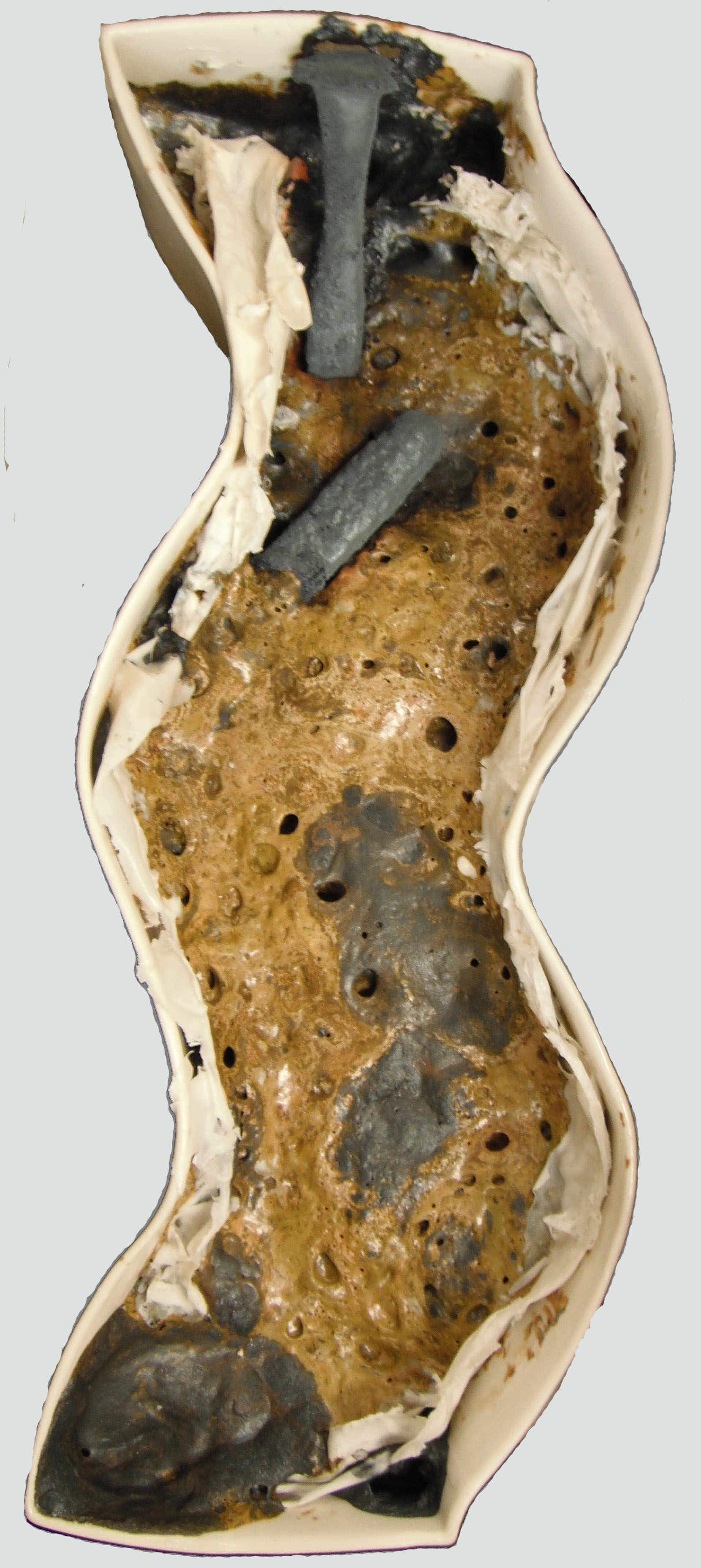
My gut feeling is that I will never tire of getting my arms sunk to the elbows in buckets of mud, nor of exploring its behaviour for myself and that, for me, the ideas belong to the artist but, in my case at least, so does the clay!  River Journey, Bridget Macklin, 2014 River Journey, Bridget Macklin, 2014 River Journey, Bridget Macklin, 2014
Farewell, Frankie

Several years ago, when I decided that I really had something that I wanted to show the world, I was uncomfortable about admitting to my work under my real name.  The reasons for this were entirely logical at the time.  Because of this I chose to advertise my work in the name of my grandmother, Frankie Boase.  Now it is time to move on.  I feel comfortable with my work, I no longer feel the need to hide behind my grandmothers skirts and I want to talk about my art under my own name.  So this blog is a final tribute to the woman whose name has helped me to launch myself.

As a child I did not really know granny all that well.  She lived in Devon for my entire childhood whilst I lived in London but I loved our annual Easter visits to my grandparents.  They always had an edge of excitement and daring about them.  Grandfather would have saved up some outlandish game or activity, normally involving water and some kind of rocket propulsion, the flag would be run up the flag pole and we would spend hours tramping over Dartmoor in the mizzle.  Our visits had something of the air of Swallows and Amazons, without the boats, about them and I loved them!

Frankie Boase
granny and grandfather on the front steps of their house in Devon

Granny was tiny!  I was taller than her at the age of about 10 and I probably weighed more than her by the time I was 6.  She had a touch of Victoriana about her; sensible shoes, long grey hair screwed into a bun, self sacrifice to an extreme that is almost never seen today.  She also had a slightly rebellious streak and that is what I loved her for.  She had clearly never been one to tow the line.  Stories of her adventures in Cornwall as a child and later on in India abound with rather risky and risqué exploits.  Indeed her diary form the summer of 1916, which I have in my possession, might have suffered censorship had it been presented to the publishers at that time!  She died at the age of 94 after a life filled with adventure and servitude and yet that is such a poor description.  She was a tough lady who I remember as always getting her own way, not suffering fools and with a fabulously adventurous spirit.

So thank you, Granny, for lending my your name for a few years whilst I found my feet but, more than that, for giving me your genes.  I value them, I am proud of them and I intend to make a success of my art now in my name but with the knowledge that you set me on my way in more ways than one.