I find myself wondering whether I put enough information into my pieces to enable the people who look at them and say they like them to know what my thinking was during the making of them. Part of me feels that I should leave it to their imagination; that people will read what they want into a piece and it is not for me to make it explicit. On the other hand I make what I do because certain things matter to me and I rather want people to know what those things are.
Maps and found clay give a piece an identity and an idea of landscape; fragile layers and the image of a very thin piece give a sense of fragility. Is that enough?
Richard Long uses the phrase ‘If I don’t walk, my art does not exist’. When I was doing the final work for my foundation degree at Weston I altered this to ‘if you don’t walk my art does not exist’. My work for that project was positioned within the landscape and I thought the meanings within it were clear. I know better now! But this is still, for me, a difficult debate.
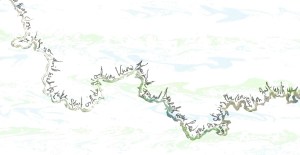
Are maps sufficient? Are they too much? Should I be including words as well or instead? I rather like the idea of words, although for some reason I then want to make them difficult to read so what on earth is the point of that?
There is some beautiful poetry which resonates so well with what I wish to say in my work that a part of me would love to include it and some fabulous quotes which would also sit well with my thoughts.

I carry a note book with me wherever I go and in it I record not just sketches and thoughts but quotes which I like. Some of these are itching to find their way into my work.
Not long ago I was introduced to the work of James Goodman. In his collection Claytown he has a remarkable piece which, just by using the names of Ordnance Survey symbols creates a fantastic image of the landscape through which he is travelling. It is a great idea and one I feel tempted to play with. On the other hand, Adam Buick adds nothing to his moonjars except the idea of landscape, letting them speak for themselves. Is this the way to go? There is absolutely no doubt that his work speaks volumes without words, images or maps.
“Adam Buick has imposed on himself the strict discipline of the simplest and purest of geometric forms. Don’t expect his spheres of fired clay to be standoffish or predictable though. Yes Adam makes white porcelain moon jars as chaste in their beauty as the old Korean dal-hang-a-ri vessels that first inspired him. But within the confines of his spherical ‘canvas’ he also conjures up worlds of spontaneous drama, pots so diverse in their scale and texture, so exquisite in their making, so alive with the Pembrokeshire landscape which they literally embody, that his passionate connection to his environment becomes unmistakable.”
Andrew Renton, Head of Applied Arts, National Museum, Cardiff
At the moment I am very conscious of our tutor, Annie Turner at City Lit who tried so hard to impress on us the idea of less being more. So for the time being, since I cannot decide what to say, I think I shall say nothing at all. People can make up their own minds and the vessels can speak for themselves. Can you hear them?

 Bridget Macklin